Sheet goods
Plywood Optimization: Kerf, Grain, and Offcut Strategy
A practical look at the three details that decide whether a plywood layout is shop-ready or just mathematically compact.

Research Lens
Why do mathematically compact layouts still fail in real shops?
The optimization target has to include shop constraints, not just area utilization. Grain direction, kerf, trim cuts, handling order, and offcut usefulness can outweigh a small percentage-point gain in yield.
Decision Metrics
Kerf Is A Layout Constraint
Blade width changes every cut line. On a dense sheet, a kerf setting that is even one millimeter too low can push the final part out of tolerance. For cabinet parts, enter the saw blade you will actually use and include any trim cut needed to square factory edges.
Grain Direction Beats Small Waste Savings
Visible panels need consistent grain, and that can cost material. A layout that rotates every part to save a few percent may still be wrong for doors, finished ends, and drawer fronts. Treat rotation permission as a design decision, not a convenience toggle.
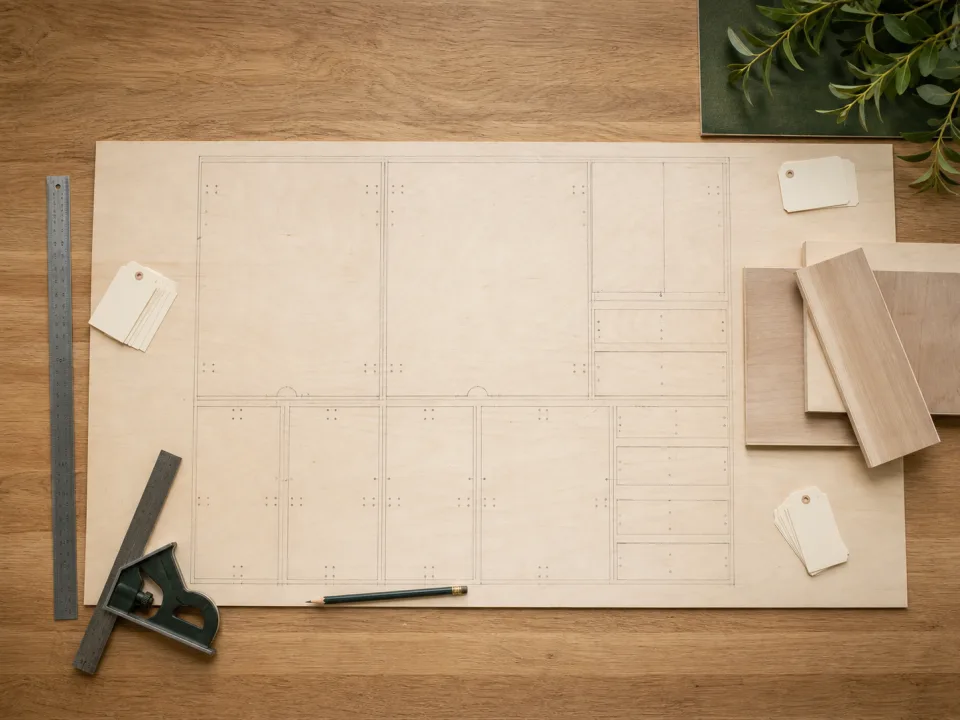
Offcuts Need A Minimum Useful Size
Not every leftover piece is worth saving. Decide the smallest offcut the shop will label and store, then optimize around that habit. A neat 300 mm strip is useful; a pile of thin slivers is just delayed cleanup.
Plan Cut Order Around Handling
A low-waste nesting result can still be awkward if it forces fragile strips too early. Put large stabilizing cuts first where possible, then break down smaller parts. Good optimization supports the person at the saw.
Field Checklist
- Use actual blade kerf.
- Disable rotation on visible grain parts.
- Define a save-worthy offcut size.
- Review cut order for handling safety.
Project Application
A maker is building a maple plywood media cabinet with visible side panels and hidden internal shelves. The layout must preserve grain direction on finished faces while still using offcuts for shelves and stretchers.
With a 1/8 inch kerf, ten rip cuts consume 1.25 inches of material before any trimming. On a tight sheet layout, that can be the difference between a shelf fitting cleanly and a part coming out undersized.
The common mistake is allowing every part to rotate because the waste percentage looks better. For visible panels, grain direction can matter more than saving a few square inches.
Check the layout with the free plywood cutting calculator, then use CutList when the project needs grain rules, saved layouts, and a shop-ready cut record.