Estimating
How Much Plywood Do You Need for a Kitchen?
Estimate plywood for a kitchen remodel: how to count sheets for base and wall cabinets, drawers, and panels, plus waste allowance and a quick method.
Research Lens
How can a personal builder use CutList to finish how much plywood do you need for a kitchen? with fewer mistakes?
The hobby workflow is strongest when the app is used as a planning checkpoint: define the project, enter accurate stock and parts, generate a visual layout, then use cost, waste, grain, kerf, PDF export, project history, and offline access to control the real cutting session.
Decision Metrics
Why a Rough Estimate Helps First
Before a detailed cut list, a rough sheet estimate tells you the order of magnitude and the budget. A typical cabinet run uses more plywood than people expect once you count sides, bottoms, shelves, backs, and drawer parts. A first estimate prevents the surprise of running short mid-project.
Estimate by Cabinet Count
A quick method is per-cabinet averages: a base cabinet uses roughly one sheet of 3/4-inch plywood including its share of drawers, and a wall cabinet a bit less. Backs come from thinner stock. Multiply your cabinet count by these averages for a starting sheet number, then refine with a real cut list.
Don't Forget Drawers, Backs, and Panels
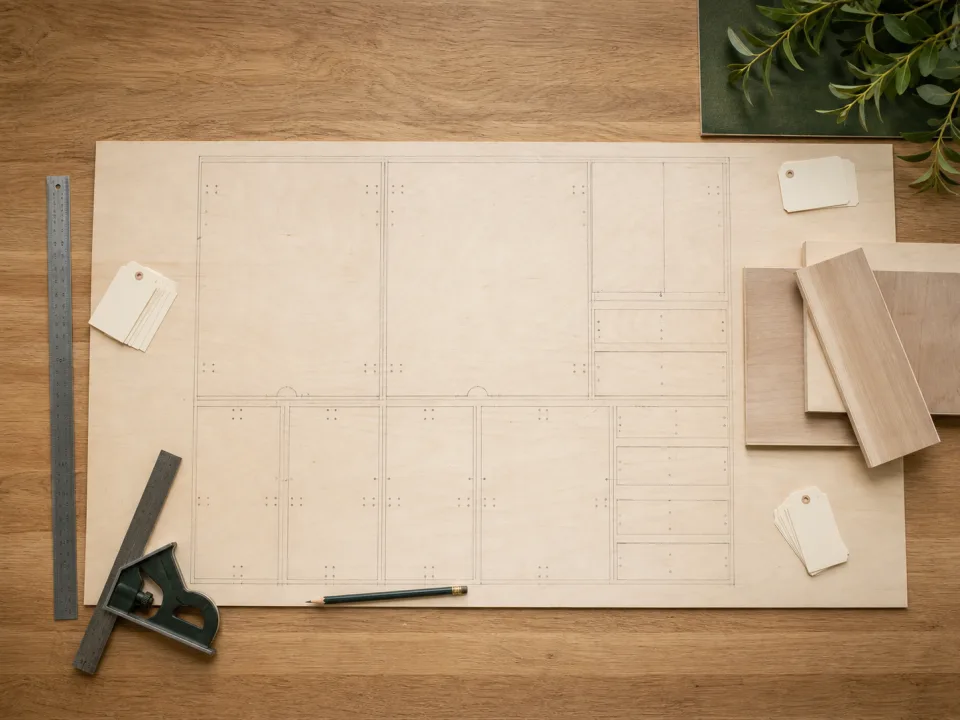
Drawer boxes, end panels, fillers, and toe kicks add up. Drawers in particular consume more plywood than expected across a kitchen. Add thinner sheets for backs and drawer bottoms. Counting only the cabinet boxes underestimates the total; include every part category.
Add a Waste Allowance
Real layouts never use 100 percent of a sheet. Add roughly 15-20 percent for kerf, offcuts, grain direction, and the occasional defect or mistake. A kitchen-sized project benefits from a modest buffer so one bad cut does not mean another trip for material.
Refine With a Real Cut List
The estimate gets you to a budget and a shopping plan; a real cut list gets you the exact number. Enter every part, set kerf, and lay them on sheets to replace the rough average with a precise count before you buy.
Compare
Rough plywood estimate per cabinet
| Cabinet type | 3/4 in sheets | Thin sheets | Note |
|---|---|---|---|
| Base cabinet | ~1 | Share of back | Includes drawers |
| Wall cabinet | ~0.6 | Share of back | Smaller panels |
| Tall/pantry | ~1.5-2 | Back | Large panels |
| Allowance | +15-20% | +15-20% | Waste buffer |
Field Checklist
- Start with a rough per-cabinet estimate.
- Count base and wall cabinets separately.
- Add drawers, backs, panels, and toe kicks.
- Include a 15-20 percent waste allowance.
- Refine the number with a real cut list.
FAQ
Common questions
How much plywood does a kitchen need?
It varies, but roughly one sheet of 3/4-inch plywood per base cabinet including drawers, less per wall cabinet, plus thin sheets for backs, then a 15-20 percent waste buffer.
How do I estimate plywood for cabinets?
Multiply cabinet counts by per-cabinet sheet averages, add drawers, backs, and panels, then refine with a real cut list for the exact number.
Do drawers use a lot of plywood?
More than people expect. Across a kitchen, drawer boxes and bottoms add up, so include them separately in the estimate.
How much waste allowance should I add?
About 15-20 percent for kerf, offcuts, grain direction, and the occasional defect or mistake, so you do not run short.
Is a rough estimate accurate enough to buy material?
Use it for budgeting and a first order, then confirm with a detailed cut list before committing to the final purchase.
Sources